Low libido is not a character flaw, a verdict on attractiveness, or a permanent condition. It is a signal. Sometimes it signals depleted hormones or a side effect of medication, sometimes accumulated stress that never fully discharged, sometimes relational habits that drain erotic energy, and often a mix of all of the above. When clients arrive in my office whispering, “I just don’t feel it anymore,” they usually carry two weights: the lack of desire itself and the shame that has layered on top of it. Sexual issues hypnotherapy works precisely in this intersection, helping people change unconscious patterns that keep desire dampened, while restoring a kinder dialogue with the body.
What low libido really means
Desire fluctuates across a lifetime. New parents often describe their libido as “on airplane mode” for months. People starting SSRIs or certain blood pressure medications notice a sudden dimming of sexual interest. Menopause and perimenopause can thin vaginal tissues and alter arousal patterns. Chronic pain or pelvic floor tension can teach the nervous system that sex equals strain. Performance anxiety in men, cultural shame in women and nonbinary clients, concern about sexual orientation or identity, conflict in a relationship, and ordinary exhaustion from a relentless schedule, all can compress desire. I have seen avid, engaged people lose their sexual spark while juggling 70 hour workweeks, and I have seen it return when we recalibrated the stress response their body had normalized as the new baseline.
It helps to distinguish three overlapping elements. There is physiological capacity, like circulation, hormone balance, and pelvic floor function. There is psychological readiness, meaning the absence of fear and the presence of safety, permission, and curiosity. And finally, there is relational context, the patterns of attention, resentment, novelty, trust, and repair in a couple. Sexual issues hypnotherapy does not claim to replace medical care or couples therapy, but it can influence all three layers, especially when paired with good coordination among providers.
Why hypnotherapy fits this problem
Hypnosis is not mind control, and it will not manufacture craving if the body is depleted or a relationship is unsafe. What it does reliably, in trained hands, is help people access focused, relaxed states where the brain is more receptive to healthy suggestions and imagery. Anyone who has driven home and barely remembered the last few turns has already experienced the light trance that hypnotherapy uses on purpose. In that state, the autonomic nervous system shifts from fight or flight toward rest and digest, breath deepens, muscles release, and long practiced mental scripts loosen their grip.
Desire is exquisitely sensitive to threat. Stress hormones, catastrophizing thoughts, traumatic memories, and fear of failure choke arousal at the root. Anxiety hypnotherapy techniques map cleanly here. When we rehearse safety in imagination, repeatedly and vividly, the brain codes that experience as real enough to reduce reactivity the next time it matters. Direct suggestions can also help reframe unhelpful beliefs: “I must feel spontaneous desire to start” becomes “I can choose to approach, and desire grows as I warm up.” In my practice, even clients who identify as highly analytical settle into trance easily with the right pacing, and they are often surprised at how quickly bodily cues, like tingling warmth or breath-led arousal, reappear once anxiety steps aside.
First rule: assess, then act
Every libido case starts with careful assessment. If someone reports a sudden drop in desire along with fatigue, hair changes, or irregular cycles, I encourage a medical workup first to check thyroid function, iron levels, testosterone and estrogen profiles, and medication side effects. If pain is present, I often collaborate with pelvic floor physiotherapists. If a client flags trauma that intrudes during intimacy, EMDR therapy can be an appropriate parallel track. The point is not to delay help, but to avoid pushing on a door that is locked from another angle.
Here is a simple checkpoint I use with new clients before we commit to a plan:
- Red flags to review with a physician: new or worsening pain with sex, bleeding, sudden loss of desire after a medication change, major mood changes, fatigue that does not respond to rest, erectile changes or decreased morning erections, drenching night sweats, and any history of trauma that currently causes flashbacks.
This list protects against missing reversible causes and respects the body’s signals. When we do proceed with hypnotherapy, we do so informed.
What a course of sexual issues hypnotherapy looks like
An initial session runs 75 to 90 minutes. We talk more than we trance. I ask about desire history, relationship dynamics, cultural messages growing up, moments when desire felt vivid, and what has worked even once. We define outcomes that feel human rather than clinical. “Have sex twice a week” is less useful than “Notice early flickers of interest and respond kindly,” or “Move from zero to a 5 out of 10 in subjective arousal within 10 minutes of warm-up.”
Later sessions settle into a rhythm. We spend a short time debriefing experiments from the week, then we do targeted trance work. The work itself takes different shapes:
- Breath priming and body scanning to downshift the sympathetic system. Guided imagery that gradually reintroduces erotic cues, first neutral and then personal. Reframing statements that target shame, fear of failure, or learned aversion. Sensation amplification, where a pleasant neutral sensation is located and dialed up to strengthen the arousal pathway. Future rehearsal, where the brain practices responding to real-life triggers with calm interest rather than avoidance.
Most clients notice a change within 3 to 5 sessions. For some, that is reduced anxiety and a bit more tenderness. For others, it is a clear return of fantasy or spontaneous desire. A full course usually runs 6 to 12 sessions spaced weekly or biweekly, with recordings to use at home. I have worked with partners together in the room when appropriate, but often the most potent work happens one on one. The outcome is not a single state called libido, but more responsiveness, less self-critique, and a reliable plan for re-stoking desire when it dips again.
The nuts and bolts inside trance
Hypnotherapy is not a script factory. Still, certain patterns work consistently.
We often start with ego strengthening, a classic approach that consolidates inner resources. Phrases like, “Each breath restores your energy, your boundaries, and your warmth,” may sound simple, but landing those statements while the body is deeply relaxed changes how clients show up for intimacy. Then we attach a cue. For one client, resting a hand on the sternum became the switch that reactivated calm arousal. For another, a scent paired to a recording served as a bridge from daily brain to sensual brain.
Desensitization has its place too. If partnered touch has become linked with obligation or anxiety, we reintroduce touch imaginally in a graded way, with the client in charge of pacing and consent at each step. We add novelty in safe doses. A client who views sex as a chore might imagine receiving two minutes of nonsexual touch while listening for micro-pleasures, then expand to five minutes the next session, then to gentle erotic touch by choice rather than duty. The brain loves specificity, so we focus on the smallest details: the coolness of sheets, the humor of a shared breath, the glow that follows when pressure leaves the room.
When shame is thick, indirect suggestion is kinder. A story about someone who re-learned desire in their forties allows a listener to borrow possibility without forcing their guard down. I remember a client in a long marriage where sex had dwindled. We talked about a couple who reclaimed playfulness by scheduling an afternoon nap together twice a week. No agenda, just slow time. The nap became their neutral zone that made desire easier to find, and my client asked their partner to try the same. Hypnosis helped cement the permission to request it without defensiveness.
Where trauma fits, and where it does not
Many people with low desire have no trauma history. Some do. For those who flinch at certain touches or who dissociate, it is essential to approach carefully. I coordinate with trauma specialists and sometimes run hypnotherapy alongside EMDR therapy. The two can complement one another: EMDR helps metabolize stuck memories, while hypnosis restores access to soothing and erotic states. It is not about revisiting every painful scene. It is about helping the nervous system learn that the present partner and present touch are not the past.
We set clear boundaries. No hypnosis should include surprise regression or interpretation of memories as facts. No touching by the therapist. Consent is continuous, with agreed stop signals. If someone is not sleeping, not eating, or actively in danger, we pause the sexual work and prioritize stability. Desire grows in safe soil.
How couples benefit even if only one person attends
I often coach clients to make two bids to their partner in the first month. The first is for structure: agree on defined intimacy windows, small at first, that remove the pressure of constant availability. The second is for novelty without threat: a gentle exchange of preferences that asks for one tiny new thing from each person. Hypnotherapy helps clients rehearse these conversations so they land without blame. When one person’s anxiety softens, both halves of the couple tend to breathe easier.
I also suggest sensate focus style home practices, adapted to comfort and culture. Start with 10 minutes of nonsexual touch in one direction, then swap. No goal. Notice sensations and communicate with simple words. Someone may think, “That is too basic.” Until they try it and realize their body has been starving for pressure-free contact, which paradoxically frees desire to return.
Medication, hormones, and practical realities
There are times when desire will not budge without addressing biology. SSRIs and SNRIs, for example, reduce libido reliably in a significant percentage of users. Some clients collaborate with their prescribers to switch to a different class, to adjust dosing time, or to add an augmenting medication. Testosterone insufficiency in men can present as low drive long before erectile issues arise. Perimenopausal estrogen shifts can alter vaginal lubrication and comfort. Pelvic floor hypertonicity, whether from childbirth, athletic training, or stress, can make arousal feel like clenching. These are tractable problems with the right professionals involved. Hypnosis can improve adherence to exercises, reduce anticipatory pain, and boost confidence, but it does not replace medical care.
Lifestyle matters, but not in a shaming way. Night shift work, heavy alcohol use, and sleep debt sap libido. So do unresolved resentments and loneliness inside a partnership. Here, life coaching tools can complement sexual issues hypnotherapy: values clarification, boundary setting, and building real rest into the week. I tell clients to expect a 10 to 30 percent lift in desire just by sleeping an extra hour consistently for a month. That is not a statistic from a single study, it is a conservative observation from practice. The brain needs recovery to want.
Managing performance anxiety and the fear of failure
Men with low desire often secretly fear erectile unpredictability. Women and nonbinary clients often fear they will disappoint a partner or that their body will not catch up to their mind. Anxiety hypnotherapy helps by unlinking arousal from outcome. We anchor attention to what can be influenced now: breath, sensation, humor, small pleasures. Practical adjustments help too. Agree that intercourse is optional. Remove the timer by choosing positions that allow a pause without breaking connection. And adopt language that resets the frame. Instead of saying “We failed,” try “We explored, and we learned what warms us up.”
One client, a 38 year old man on an SSRI, dreaded that familiar moment when arousal slid away. In trance, we rehearsed that exact scenario five times, each with a different response he could choose. In one version he shifted to kissing and touch without apology. In another he activated the breath cue we had installed earlier. In a third he asked for a short break and returned. After two weeks of practice, the real moment arrived, and he reported three words he had never associated with that situation before: “No panic, options.”

What success looks like, and how to measure it honestly
Success is not constant fireworks. It is a greater ease starting, more frequent moments of genuine interest, and less dread. I ask clients to track two simple things. First, how often they notice any spark in a day, even a 1 out of 10. Second, how quickly they can move from neutral to a 4 or 5 with warm-up. Improvement shows up as higher frequency of sparks and shorter warm-up times, even if orgasm frequency takes longer to shift.
Formal measures can help if a client likes numbers. Tools like the Female Sexual Function Index or brief desire scales can be completed monthly to see trends. But I put more weight on narratives people tell themselves. When someone moves from “I am broken” to “I am warming up differently,” we are well on our way.
A brief case vignette
Names and details changed for privacy. A couple in their mid forties came in after three sexless years. She described herself as a “head in a jar,” living from the neck up while raising teens and running a team at work. He had stopped initiating out of fear of rejection. Both were affectionate, both resigned.

Session one https://revibetherapy.com/services/anxiety-hypnotherapy/ established physiology. Menopause was not yet in play, thyroid was stable, and no trauma history was active. We set one goal: restore curiosity. Sessions two through five focused on body awareness, five minute nightly practices, and reframing. We paired a peppermint scent with trance so they could anchor calm arousal at home. We built a “low effort menu” of intimacy options like showering together without sex, or a 12 minute massage swap.
By week four, she reported a surprise: fleeting fantasies returned on commutes. By week six, they scheduled intimacy windows on Sunday afternoons twice a month, a time when she still had bandwidth. By week eight, they were having intercourse sometimes, but more importantly, the dread was gone. That couple’s outcome is not a template, just one arc among many. What mattered most was that both people participated and allowed the process to be iterative rather than all or nothing.
Integrating other hypnotherapy specialities without diluting focus
Clients often ask whether their low libido is connected to other habits they want to change. Sometimes it is. Smoking hypnotherapy techniques can be adapted to unhook ritualized porn use or late night scrolling that blunt desire. Weight loss hypnotherapy tools that target emotional eating can cross over to address numbing habits that compete with intimacy. These are not the same problems, but they share circuitry: reward prediction, stress relief, and habit loops. Using those tools judiciously can clear runway for sexual energy to return.
What you can practice at home, starting now
Self hypnosis is not a lesser version of therapy sessions. It is the practice that makes new responses familiar. A simple 10 minute routine, recorded in your own voice or guided by a therapist’s audio, can change the tone of your evenings. Here is a minimal structure that works for many people:
- Three minutes of slow breathing and progressive muscle release, two minutes amplifying a pleasant neutral sensation, three minutes imagining a warm, pressure-free intimacy scene that stays within comfort, and two minutes installing a cue like a phrase or touch you can use later.
Keep it gentle and repeatable. If shame or discomfort rises above a 4 out of 10 during practice, open your eyes, move your body, and return to neutral. The goal is to teach your nervous system that erotic states are safe, not to power through.
When to pause hypnotherapy and shift gears
If desire remains flat after a thorough trial of 6 to 8 sessions, I revisit the map. Persistent pain, relationship betrayals, active substance dependence, untreated depression, or hormones in flux can override the best hypnotic work. That is not failure, it is information. Sometimes the next right move is couples therapy, a medication review, pelvic floor work, or a defined break from trying for a month to reduce pressure. Hypnotherapy is most effective as part of a thoughtful ecosystem, not as a lone hero.
What a qualified practitioner looks like
Look for someone registered with a recognized hypnotherapy or psychotherapy body, trained in sexual issues hypnotherapy specifically, and comfortable collaborating with medical providers. Ask how they handle consent, boundaries, and trauma. Competent therapists will welcome those questions. They should also be clear about what they will not do: no touch, no guarantees, no diagnosing medical conditions. If a therapist dismisses medical evaluation or promises to fix everything in a single session, keep looking.
Realistic expectations and the long view
Most people I see experience meaningful improvement within two to three months. Meaningful does not always mean dramatic, but it often includes a steadier baseline, easier warm-up, and less avoidance. Relapses happen. Busy seasons, illness, grief, and conflict can cool desire temporary. The measure of progress is not whether dips vanish, but whether you know how to rekindle. That is where ongoing self hypnosis, kind communication, and small rituals of connection carry you. People who keep one weekly practice, even five minutes, tend to maintain gains. Those who let the practice fade often return months later asking for a tune-up. That is fine. Bodies and relationships are living systems, not projects to complete.
A client once told me, six months after finishing, “We are not on fire every week. But I know where the matches are, and I am not afraid to strike one.” That line sits in my notes as a reminder of what this work is really about: not performance, not frequency quotas, but confidence and choice.
Final thoughts from the consulting room
Desire does not respond well to scolding. It prefers oxygen, attention, novelty, and patience. Sexual issues hypnotherapy creates those conditions internally, and then couples can create them externally. If you recognize yourself in any of this, start with one small step. Schedule a checkup if something feels off physically. Choose a therapist who understands both hypnosis and sexuality. Begin a short, daily practice that invites your body back into the conversation. If anxiety crowds the doorway, bring anxiety hypnotherapy tools to quiet the noise. If old memories intrude, consider pairing the work with EMDR therapy. If habits keep stealing your evenings, borrow life coaching strategies to protect time and energy.
Low libido is a message. When you learn to hear it without judgment, and respond with skill, desire rarely stays silent for long.
Address: 1850 Lee Rd. #122, Winter Park, FL 32789
Phone: (407) 801-2191
Website: https://revibetherapy.com/
Email: [email protected]
Hours:
Sunday: Clinician 9:00 AM - 1:00 PM
Monday: Front Desk 9:00 AM - 5:00 PM
Tuesday: Front Desk 9:00 AM - 5:00 PM; Clinician 10:00 AM - 3:00 PM
Wednesday: Front Desk 9:00 AM - 5:00 PM; Clinician 4:00 PM - 7:00 PM
Thursday: Front Desk 9:00 AM - 5:00 PM; Clinician 10:00 AM - 4:00 PM
Friday: Front Desk 9:00 AM - 5:00 PM
Saturday: Closed
Open-location code (plus code): JJ4G+5F Winter Park, Florida, USA
Map/listing URL: https://www.google.com/maps/place/Revibe+Therapy/@28.6054193,-81.3738038,17z/data=!3m1!4b1!4m6!3m5!1s0x88e771e2aaa7bacd:0xb3b93f270087b1fb!8m2!3d28.6054193!4d-81.3738038!16s%2Fg%2F11ghtgxkbv
Embed iframe:
Revibe Therapy provides hypnotherapy and related therapy services from its Winter Park office, with online therapy also available through the practice website.
The practice describes itself as a group practice specializing in Cognitive Hypnotherapy and EMDR, with service pages covering anxiety, confidence, smoking cessation, sports psychology, and other concerns.
People exploring individual therapy, couples therapy, teen therapy, sports psychology, and online support can review the service menus and location pages to see whether the practice is a fit.
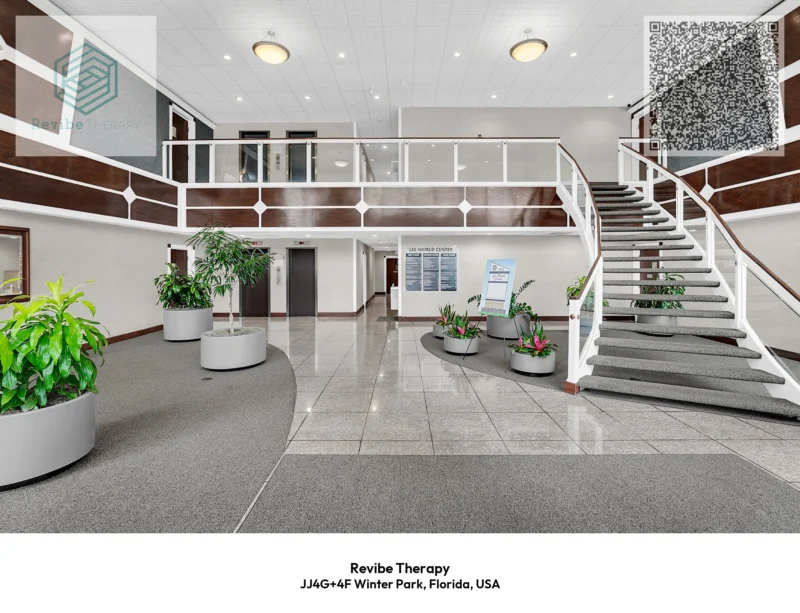
For local visitors, the Winter Park office is listed at 1850 Lee Rd. #122, Winter Park, FL 32789, placing the practice within the wider Winter Park and Orlando service area shown on the site.
The website presents a structured approach that combines mind-body methods with evidence-based psychology, which may appeal to people looking for a more focused alternative to talk-only support.
Front desk hours are listed Monday through Friday, and the Winter Park page also provides separate clinician hours on select days for local planning purposes.
To ask about availability or next steps, call (407) 801-2191 or visit https://revibetherapy.com/.
For directions and map context, the public listing for this location is https://www.google.com/maps/place/Revibe+Therapy/@28.6054193,-81.3738038,17z/data=!3m1!4b1!4m6!3m5!1s0x88e771e2aaa7bacd:0xb3b93f270087b1fb!8m2!3d28.6054193!4d-81.3738038!16s%2Fg%2F11ghtgxkbv.
Popular Questions About Revibe Therapy
What services does Revibe Therapy offer in Winter Park?
Revibe Therapy’s website lists Cognitive Hypnotherapy, EMDR, online therapy, sports psychology, individual therapy, couples therapy, teen therapy, and several topic-specific hypnotherapy services such as anxiety, confidence, smoking cessation, and related concerns.Where is the Winter Park office located?
The Winter Park office is listed at 1850 Lee Rd. #122, Winter Park, FL 32789.Does Revibe Therapy have more than one office?
Yes. The website lists Winter Park and Lake Nona locations, and it also promotes online therapy through the main site.What hours are listed for the Winter Park office?
Front desk hours are listed Monday through Friday from 9:00 AM to 5:00 PM. Separate clinician hours are listed for Sunday 9:00 AM to 1:00 PM, Tuesday 10:00 AM to 3:00 PM, Wednesday 4:00 PM to 7:00 PM, and Thursday 10:00 AM to 4:00 PM.Does Revibe Therapy accept insurance?
The Winter Park location page states that insurance is not accepted.Is online therapy available?
Yes. The site includes an online therapy section in addition to the Winter Park and Lake Nona office pages.Is hypnotherapy the only service listed on the site?
No. While hypnotherapy is a major focus, the site also lists EMDR, sports psychology, individual therapy, couples therapy, teen therapy, and online therapy.How can I contact Revibe Therapy?
Call tel:+14078012191, visit https://revibetherapy.com/, and use the public Winter Park map listing above for directions.Landmarks Near Winter Park, FL
Lee Road Corridor — The Winter Park office is directly on Lee Road, making this corridor one of the clearest local reference points for directions and nearby coverage. If you are near Lee Road and I-4, Revibe Therapy’s Winter Park page and public map listing give a straightforward starting point.Park Avenue — Park Avenue is one of Winter Park’s best-known shopping and dining districts and a useful downtown reference point for local service-area copy. If you spend time around Park Avenue, the Winter Park office is part of the same broader local area.
Central Park — This downtown Winter Park park sits on Park Avenue and regularly anchors community events. If you are near Central Park or the surrounding retail blocks, Revibe Therapy’s Winter Park location is a practical nearby reference for local therapy services.
Rollins College — Rollins College is a major Winter Park landmark at 1000 Holt Ave. If you are a student, staff member, or nearby resident, the Winter Park office provides a recognizable local option to reference online or by phone.
Mead Botanical Garden — Mead Botanical Garden is a well-known Winter Park park and nature destination. If you are coming from the Denning Drive or garden area, the practice remains within the wider Winter Park service footprint shown on the site.
Hannibal Square — Hannibal Square is a historic Winter Park district with shops, dining, and neighborhood activity close to downtown. If you are near Hannibal Square, Park Avenue, or the surrounding streets, the Winter Park office is an easy local point of reference.
Winter Park Village — Winter Park Village is a mixed-use shopping and dining destination that many local visitors recognize immediately. If you are near Winter Park Village, Revibe Therapy’s Winter Park office is part of the same practical local coverage area.
Winter Park Scenic Boat Tour — The Scenic Boat Tour is one of the city’s most familiar visitor landmarks and operates from East Morse Boulevard. If you are near the boat tour, downtown canal area, or nearby college and park districts, the Winter Park office is still a useful local reference for directions and scheduling.
Orange Avenue — Orange Avenue is one of the best-known gateway corridors between Winter Park and Orlando. If you travel the Orange Avenue corridor regularly, Revibe Therapy’s Winter Park office is positioned within that broader local access pattern.